Cybersecurity for Startups: Smart Ways to Stay Protected
In today's fast-paced digital world, startups are constantly innovating and scaling their businesses. While growth is the primary focus, cybersecurity often takes a back seat. However, cybercriminals frequently target startups because they typically have limited security resources and fewer protective measures in place. Investing in cyber security for startups from the beginning helps protect sensitive business data, build customer trust, and support long-term growth. As cyber threats continue to evolve, implementing proactive security measures early can help startups reduce risks and avoid costly data breaches.
Why Startups Are Prime Targets for Cybercriminals
Startups are uniquely vulnerable to modern digital threats for several distinct reasons:
- Limited Budgets: Advanced security tools and dedicated security staff require capital that early-stage companies frequently prioritize toward product development, customer acquisition, and marketing.
- Rapid Onboarding: Remote or hybrid teams using personal devices under Bring Your Own Device (BYOD) policies can inadvertently introduce security gaps and unmanaged endpoints.
- Valuable Data Assets: Even if your enterprise is small, you hold sensitive customer data, valuable intellectual property, proprietary source code, and payment information that bad actors can exploit or sell on the dark web.
- Third-Party Integrations: Startups heavily rely on various third-party SaaS tools and APIs, each of which can potentially serve as an entry point for attackers if improperly configured.
Protecting your digital assets doesn't require a Fortune 500 budget. By adopting smart, foundational habits early on, you can safeguard your enterprise against sophisticated digital threats.
Common Cybersecurity Mistakes Startups Should Avoid
Even startups with great products can become easy targets when basic security practices are overlooked. Some of the most common mistakes include:
- Using weak or reused passwords across multiple accounts.
- Delaying software updates and security patches.
- Giving employees unnecessary access to sensitive data.
- Failing to back up critical business information.
- Ignoring security awareness training for employees.
Avoiding these common mistakes can significantly reduce security risks and strengthen your overall protection strategy.
6 Smart Ways to Improve Cyber Security for Startups
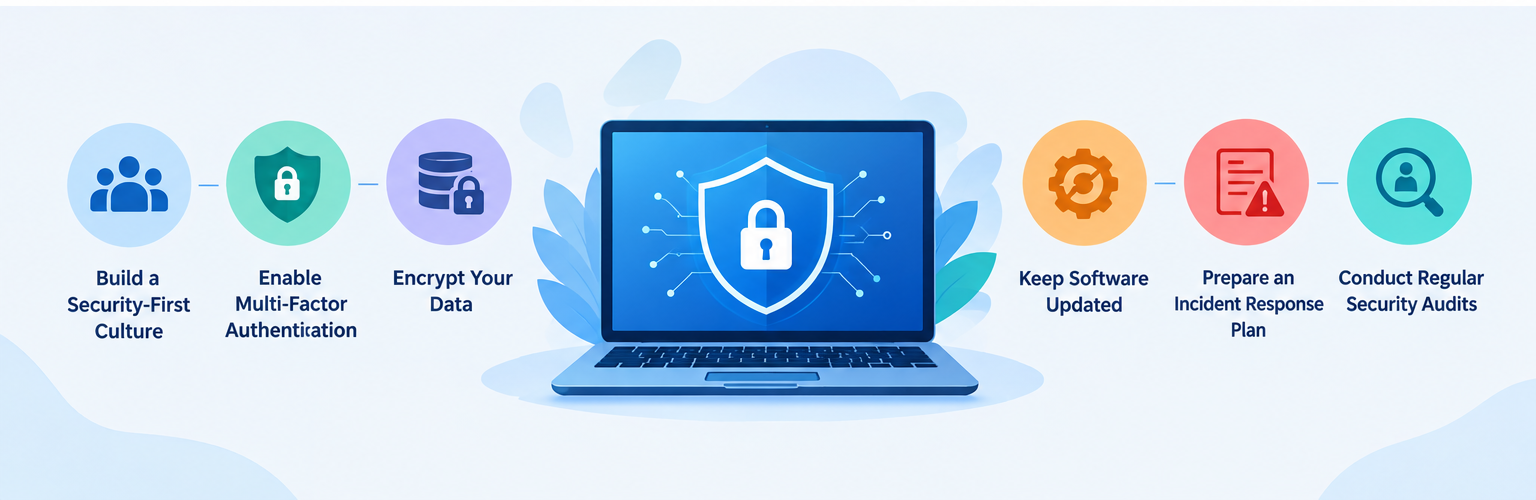
1. Cultivate a Security-First Culture
Your employees represent your absolute first line of defense—and unfortunately, they are often your biggest vulnerability as well. Human error accounts for the vast majority of all security breaches globally.
- Conduct regular, engaging awareness training sessions to help your team spot sophisticated phishing emails, social engineering tactics, and suspicious links.
- Establish clear, enforceable internal policies regarding password management, device locking, and safe data-sharing practices across all departments.
2. Implement Multi-Factor Authentication (MFA) Everywhere
Simple passwords alone can easily be compromised through brute-force attacks, credential stuffing, or phishing schemes. Requiring multi-factor authentication across every single company account—ranging from corporate email and cloud storage to project management tools and developer repositories—adds an essential layer of verification that drastically reduces unauthorized access.
3. Encrypt Sensitive Data at Rest and in Transit
Encrypt sensitive data both in transit and at rest. Even if attackers intercept encrypted information, they cannot access it without the appropriate decryption keys. This is especially important when handling customer or financial data.
4. Regularly Update, Patch, and Monitor Software
Outdated software contains known vulnerabilities and unpatched bugs that automated botnets and malicious actors scan for on the web daily. Ensure that your operating systems, browser plugins, third-party applications, and network firewalls are set to update automatically or are managed tightly by your engineering team.
5. Establish a Comprehensive Incident Response Plan
Hope is not an effective business strategy. You must operate under the assumption that a security incident could happen at any time, and outline a clear, step-by-step plan for threat containment, internal and external communication, and data recovery. Knowing who to call and what immediate actions to take can minimize downtime and mitigate financial damage.
6. Conduct Regular Security Audits
Regular security audits and vulnerability assessments help identify weaknesses before cybercriminals can exploit them. Reviewing your systems, applications, cloud infrastructure, and user permissions on a regular basis enables your business to stay ahead of evolving threats. Periodic assessments also help ensure compliance with industry standards and data protection regulations.
Tailoring Defenses for Smaller Operations
When scaling an emerging business, resource allocation is everything. Founders often wonder how to balance growth speed with safety. Focusing on fundamental practices of cyber security for small businesses helps bridge this gap. You do not need the most expensive enterprise suite on day one; instead, focus on high-impact security measures such as endpoint detection, automated cloud backups, and strict identity and access management controls. By securing the foundational layers of your tech stack, you significantly lower your risk profile without choking business agility.
For example, a SaaS startup handling customer information should enable multi-factor authentication, encrypt customer databases, perform regular cloud backups, and continuously monitor user access. These simple yet effective practices can prevent costly security incidents before they occur.
Building Long-Term Value Through Security
Focusing on robust security protocols does much more than simply prevent malicious attacks; it actively builds market trust. Enterprise clients, institutional investors, and modern privacy-conscious consumers want absolute assurance that their data is safe in your hands. Treating security as a competitive advantage rather than a bureaucratic hurdle sets your startup apart from competitors who treat safety as an afterthought.
Furthermore, compliance requirements are becoming increasingly stringent globally. Integrating privacy and security measures early ensures that as your company scales into new markets, you won't have to overhaul your entire infrastructure to meet regulatory standards like GDPR, CCPA, or industry-specific frameworks.
Conclusion
In the fast-evolving startup ecosystem, growth and security must go hand in hand. Waiting for a cyber incident to occur before taking action is a costly mistake that many young companies fail to survive. By fostering a culture of security awareness, implementing fundamental safeguards like multi-factor authentication and encryption, and maintaining reliable data backups, you create a resilient foundation for your enterprise. Prioritizing cyber security for startups today ensures that your innovative ideas, valuable data, and hard-earned reputation remain fully protected as you scale toward tomorrow's success.
Frequently Asked Questions (FAQs)
What is the biggest cybersecurity threat to startups?
Phishing and social engineering attacks are among the most common and dangerous threats facing modern startups. Hackers manipulate unsuspecting employees into revealing login credentials or downloading malicious file attachments, effectively bypassing traditional technical firewalls.
Do small businesses really need professional security tools?
Yes, absolutely. Implementing basic security solutions like endpoint protection, centralized password managers, and reliable cloud backups is crucial. Focusing on foundational cyber security for small businesses prevents minor technical vulnerabilities from turning into catastrophic financial losses.
How often should we back up our company data?
You should follow the industry-standard 3-2-1 backup rule: keep at least three copies of your critical data, across two different storage types, with at least one copy stored safely offsite or in the cloud. Automated daily backups are ideal for fast-growing startups.
When should a startup start prioritizing cybersecurity?
From day one. Integrating security into your software architecture, company culture, and daily operations from the very beginning is much easier, more effective, and significantly cheaper than trying to patch severe vulnerabilities after a major data breach has already occurred.
How can startups protect customer data?
Startups can protect customer data by implementing strong passwords, enabling multi-factor authentication, encrypting sensitive information, regularly updating software, and educating employees about cybersecurity best practices.
What cybersecurity tools should startups use?
Essential cybersecurity tools include endpoint protection software, firewalls, password managers, cloud backup solutions, vulnerability scanners, and security monitoring tools. Choosing the right combination depends on your business size and operational needs.
For more details
Get in Touch